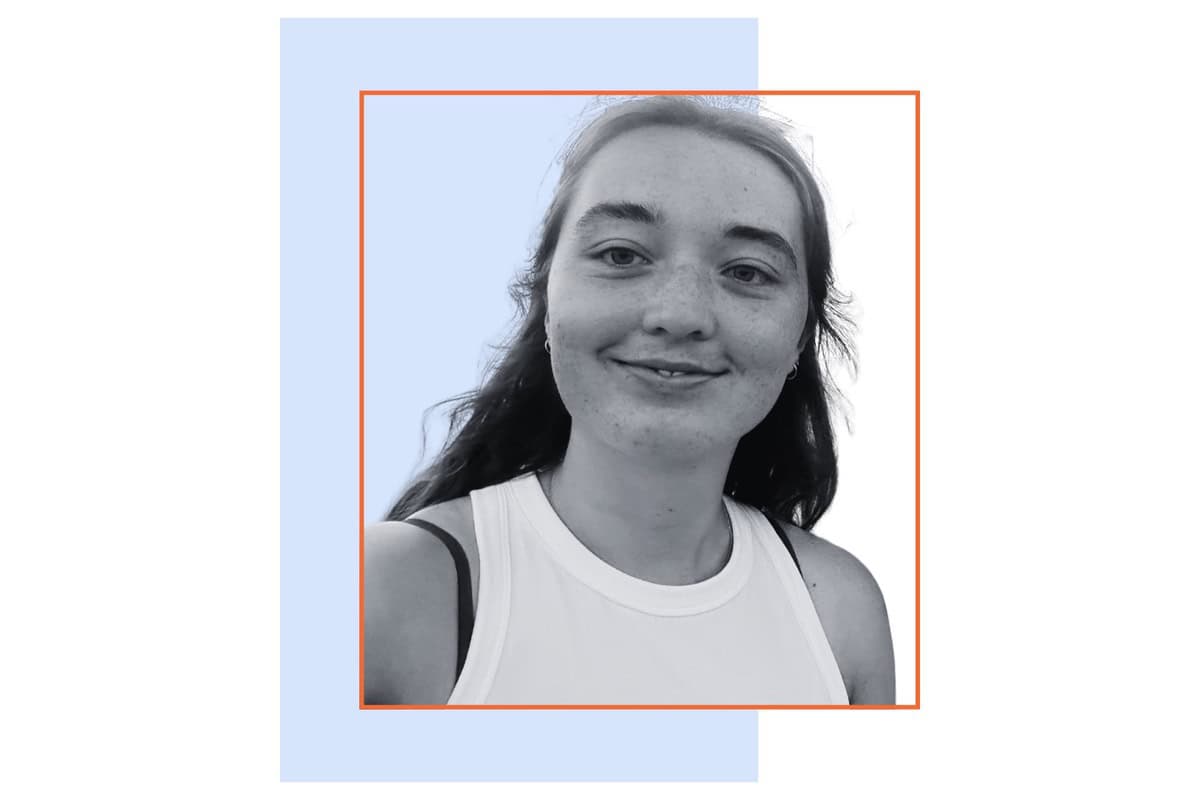
Thank you to Kendall Rice for sharing her R.E.A.L® life with us! Kendall is a 9th- and 10th-grade English teacher at Blair Academy in Blairstown, NJ. She spoke with us about why class discussion has been an essential tool for increasing student engagement and ways that she structures discussion for student success. This interview has been lightly edited for clarity.
Hometown: Rye, New York, in Westchester County
Current School: Blair Academy in Blairstown, New Jersey. This year, I’m teaching 9th- and 10th-grade English. The classes are called English 1 and English 2.
Take me back to when you were a student. Describe yourself as a student in a few words.
Oh my gosh. I was an engaged student, I would say. I engaged with the material, homework, teacher and classes. I wasn’t skeptical of the whole setup. So engaged, and also probably anxious.
What drew you to teaching?
My path to teaching is funny. I went to boarding school. I loved my boarding school. I loved all the teachers there in particular, and the dorms, just the faculty. I was voted most likely to work at my boarding school as my senior superlative, and I was like, “That’s so embarrassing! I’m never gonna do that.”
Then in college, I majored in both chemistry and English. I was a camp counselor for a few years, and I loved that, but then I did some chemistry research, and I hated that. So when I was thinking about what job I wanted after I graduated, I was pulled mostly towards education. And then I met Blair at a career fair.
That is so neat to hear! When you think back to a favorite teacher, who was it and why?
I think about my freshman English teacher, Mr. Seebeck from Loomis Chaffee. I liked that class because it felt intellectual but fun. It wasn’t sitting in lines and taking notes necessarily. It was just talking about books, and that was my first taste of that.
Then in college, I had two teachers who were kind of crazy. They would walk around the room and sort of yell things and sit on desks. One in particular was really good at getting people to say things, then translating what they said to the wider group, adding to it, and making the analysis more rigorous. I remember watching him and being like, I want to teach like that. That’s awesome.
When it comes to class discussions, what is your why? What feels compelling and important about teaching these skills now?
For class discussion, honestly, in English in particular, it’s forcing them to be thoughtful about their place in the world, because a lot of it is pulling things out of the text and paying attention. My big goal overall is to get them to care more deeply about things, because a lot of them have a lot of apathy and don’t care very much. And I think part of the way to do that is through understanding. So it’s working together towards a place of understanding.
But then also, they don’t always ask themselves big questions, and books are a good place to get at those questions in a safe way. They don’t immediately have to apply the questions to themselves, but can eventually work towards doing that. And I think it’s better when it’s a discussion, because it’s easier to BS a little bit when you’re just writing something. But when there’s accountability between peers, it’s harder to do that.
I think that’s really interesting. I’m so curious: do you think the apathy thing is a generational thing, or just typical for ninth grade?
I don’t know, because I’ve only been teaching for two years, so I have no frame of reference for the past 20, 30 years. I will say, though, that I think generally people my age and younger have grown up with a lot of “the world is terrible and it’s gonna end,” blah, blah, blah, and a response to that is, well, I just can’t care about that. It’s too much. And then add on top of that how we’re able to escape and self-soothe with phones and social media instead of alternatives. I think that adds to it.
We think about that a lot in our work with schools! It leads into another question we’re grappling with: you are currently preparing high schoolers for an uncertain future, especially with AI. What skills do you think are most important for preparing students for an uncertain future?
I think the way I deal with the uncertain future question is by not feeling like I’m teaching them to get a job or to have a job. That is not part of what I care about at all. So if a student asks, “Why does this matter? What does this have to do with us having a job one day?” I’m like, “Well, that’s not what I’m doing. That’s not my job.” All I want is for them to care more deeply about the world around them, and want to engage with the world around them, and be thoughtful, well-rounded citizens of the world. And I think R.E.A.L.® Discussion is one of the tools for getting at that.
That’s a good point. When it comes to R.E.A.L.®, which discussion skills do you think factor most into that vision?
What I’ve realized is that the question-asking piece is the most important thing to me, because it sort of encompasses all of it. They’re listening to each other, they’re synthesizing what people are saying and applying it to what they’re thinking about, and then coming up with a question that continues the conversation and also just follows their interest.
What do you do when students aren’t asking questions? Do you have a move as a teacher to help them figure out how to ask a question or when?
After our first DQ (discussion question), I’ll often stop. Sometimes I’ll do it at the end of the discussion, sometimes after one or two questions. I stop and say, “I liked this point. Somebody should have gone deeper on that, though. They made this claim and nobody asked them to elaborate further,” or, “This claim contradicted this claim, and we didn’t talk about that at all.” So I’ll stop and say, “These are the things you should be noticing.”
I also will shout out when somebody asks a question. Ideally, the students are the ones shouting out when somebody asks a question, and they notice that it moves the conversation in a new way. I have had that happen before, but sometimes I’m the one who’s like, “Did you guys notice when this happened?” I think I just talk about it a lot, and they do start to do it more and more because they know that’s what I’m looking for.
A lot of the feedback I give them is that I take notes as they speak, and I also write down the way I would respond or the questions I would ask. Usually that’s just what I tell them as we go: this person said this thing, and this is the question I would have asked. And they really like that.
That’s really cool. Do you find that they start to mimic you in some way, or put that into practice?
I think so. I have started to see it, and I do see it when I stop in the middle of a discussion and say something. I see it for the next question.
Can you think of a moment, this year or last year, when a student had a breakthrough in a discussion? What did it look like, how did it feel as a teacher, and what impact did it have?
This year, there was a moment when somebody said something that wasn’t reiterating what previous students had said. A lot of what we started with was excerpting and then I noticed they were stating the same things over and over. And somebody was like, “But actually, that doesn’t make sense because of X, Y, Z.” Everybody in the class was like, “Oh my god! What? That’s so true.” Then they talked about that for a while, and in the shout-outs after class, a lot of them said, “I loved what she said here. It just changed the direction of our conversation completely.” So that was fun.
Last year, and this is a little bit of a variation on the foundation we laid in R.E.A.L®, I had students pretend to be me. Somebody would come to class, and I’d be like, “Okay, you’re going to pretend to be me today.” They would either have questions I had prepared, or just things they wanted to talk about, and they’d stand at the front of the class and mimic what I was like in a discussion when it wasn’t R.E.A.L.®, when it was teacher-led.
And honestly, all of the students really wanted to help out that student, so they were really great. They were great at asking each other questions and keeping the conversation going. And the one student acting as the facilitator was pretty much only translating what the other kids were saying and then asking follow-up questions.
There was one person in particular where I was like, this was awesome for you. This student hadn’t been super confident in class and hadn’t been doing that well. But he loved this book, and he was able to lead the discussion and talk about the things he wanted to talk about, and it worked really well.
That is such a cool move, because they’re getting that extra practice without it feeling like extra work or that they’re singled out. But it’s basically training that person to learn how to repeat back: did I hear you right?
Yeah, it wasn’t graded, and I didn’t tell them it was a R.E.A.L.® Discussion, but it was. It was just that one person was the facilitator. It was really great at the end of the year, because they had really picked up a lot of my methods, and they could have fun with that a little bit when they mimicked me.
One thing that’s coming up a lot, especially among high school teachers, is what to do about DQ Prep and AI. Do you have a go-to method for handling that?
Great question. I do something that’s probably crazy. They don’t get their questions before class. They know if they’re going to have a discussion, and they do the reading, and maybe they prep in whatever way. But I come up with the questions before class. They get 25 minutes at the beginning of class to find quotes, quickly write down ideas, and write down any questions they have, and then they just have to go and do it. So we don’t have super long discussions, but with AI, that’s kind of how I have to do it. The actual discussion is about 30 minutes. Sometimes we won’t finish, and I have done it where we continue the next class, but they leave their books in class, so they’re not doing any more prep outside of class. I like them to have some prep, but I don’t want them to prep too much and then only be looking at their book for things to say.
I think that’s true with or without AI, right? We don’t want them reading off a script anyway.
Yeah, exactly. That’s why I don’t mind doing the shorter in-class preparation.
That makes a lot of sense! Okay, last two-part question for you: what is inspiring you at the moment? Do you have a favorite quote right now?
My tennis season just ended, so I want to start going to watch other English teachers in the department, because I have not watched enough other teachers as a new teacher. I need to do that more, and I think they are going to inspire me.
As for a quote, I like this one. John Green has this little story about how he worked as a chaplain at a children’s hospital, and his mentor chaplain used to say, “Don’t just do something; stand there.” You can’t always fix things, but you can just be there. And I like that.
That is a beautiful quote. Thank you so much for talking with us today, Kendall!