
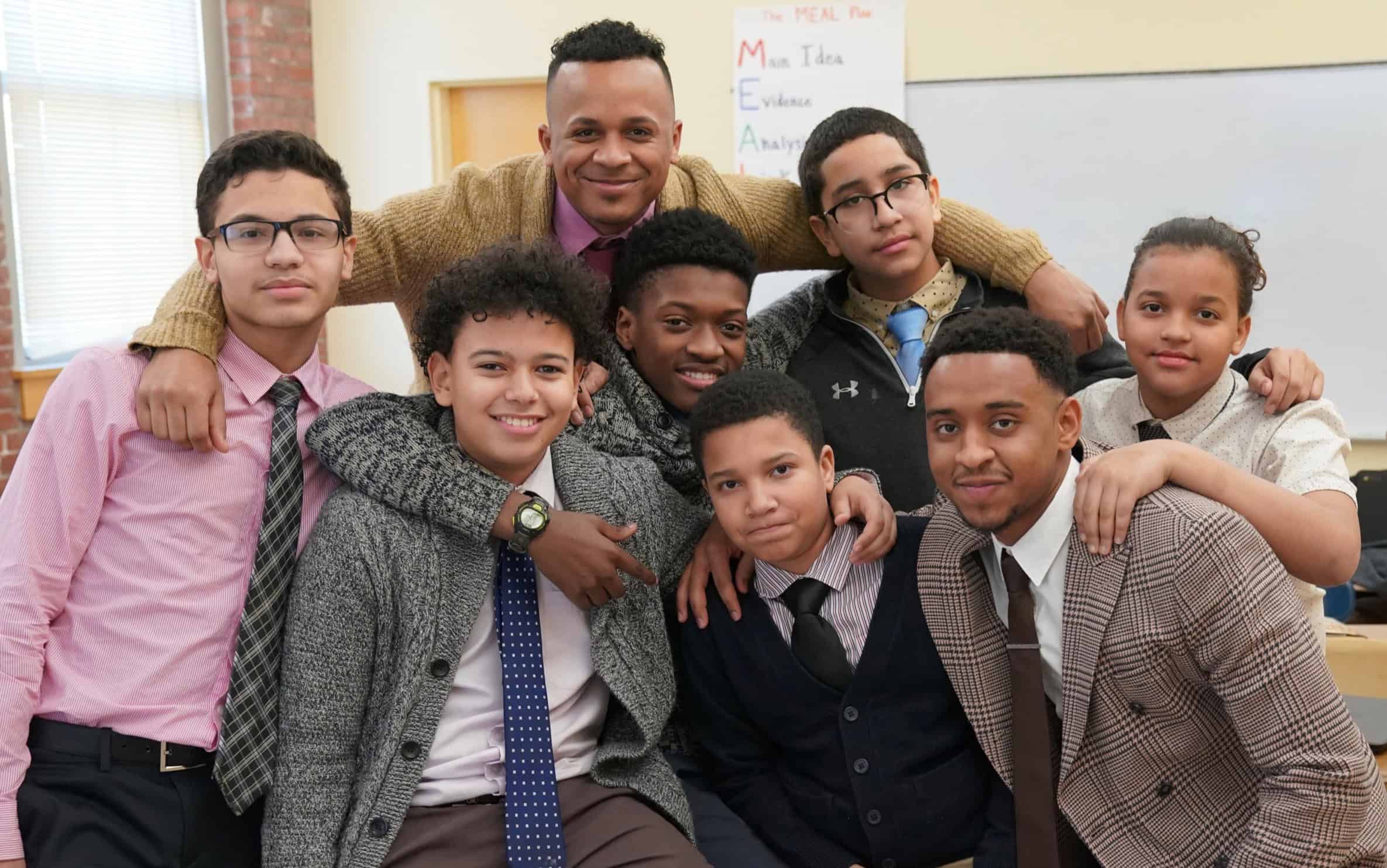
Breaking Discussion into Teachable Skills
A Case Study of R.E.A.L.® Discussion at Nativity Preparatory School, Boston MA
R.E.A.L.® Discussion · October 2023 · hello@realdiscussion.org · realdiscussion.orgAbout the School
Nestled in Jamaica Plain, Boston, Nativity Prep provides a transformative, tuition-free Jesuit education to boys from low-income families. Its intensive academic, after-school, and graduate programs empower young men of color to break the cycle of poverty, to thrive in high school, college, and career, and to become compassionate “men for others.”
The School is well-known and respected – and for good reason! Nearly 55 young men in 5th-8th grade learn, grow, serve, and pray at the school each day, guided and supported by a professional faculty, dozens of skilled volunteers, and hundreds of committed benefactors. The school’s 350 alumni currently study at the area’s best independent high schools and colleges, work in a vast range of industries, and contribute to their neighborhoods through civil and community service.
President Brian Maher realized that achieving Nativity Prep’s mission – in which students grow in character, deepen their faith, and develop transferable academic skills – required a foundational skill set: the ability to express oneself and listen deeply to others.
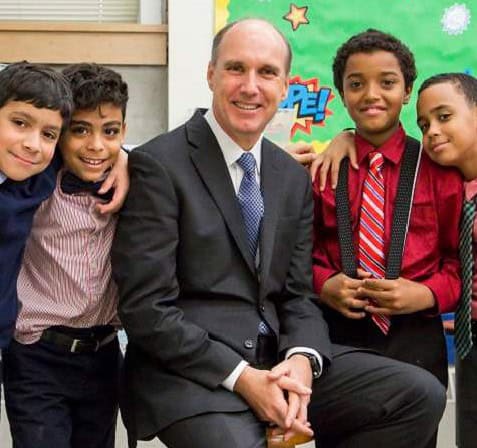
“The Nativity Prep mission is rooted in developing relationships that find the goodness and dignity in each person so that we can grow together. R.E.A.L.® has been an essential tool that gives our students the skills and confidence to both listen and be heard.”
Brian Maher
President
The Vision
Francisco Castillo-Fierro, Assistant Principal, and Patrick Farmer, Middle School Humanities Lead, understood the urgency – and power! – of explicitly teaching discussion skills. “At Nativity Prep, we believe in the power of everyone’s voice,” explains Francisco. “We also know that in today’s world, it can be hard and scary to have conversations that include everyone’s voices – especially when you disagree or feel as if you can’t connect with someone else’s perspective. It’s easy to get angry, or quiet, or feel alone when you’re the only one who knows a certain experience or thinks a certain way.”
Though they remained sensitive to the struggle today’s students may face when embarking upon challenging in-person conversations, Francisco and Patrick had a clear vision for what they knew their students could achieve with the right training.
Patrick had come to Nativity Prep from another leading independent school, where he had been trained in the R.E.A.L.® Discussion method. He saw R.E.A.L.® as the perfect tool to “demystify discussion” for his students and break the art of discussion into teachable, practice-able, transferable skills that boys could name, practice, and use in and beyond school.

Francisco Castillo-Fierro | Assistant Principal
The Strategy
Patrick introduced R.E.A.L.® Discussion to his sixth graders through a winning metaphor: discussion, he posited, is just like basketball! In discussion, you have choices about what “moves” to make each time you talk – just as in basketball the ball-handler asks himself: should I dribble, pass, or shoot? And, like basketball, discussion is fundamentally a team sport, not something an individual can win or lose.
Using the R.E.A.L.® framework, discussion comes with a similar selection of “moves” from which a speaker can choose:
- Relate – make connections across texts, experiences, and ideas.
- Excerpt – use evidence to ground the conversation.
- Ask – pose questions that open the discussion further.
- Listen – make your listening visible to your teammates.
Likewise, Patrick positioned himself as a Coach rather than a referee or a star-player – both roles he had found himself squeezed into when using other discussion methods. Patrick wanted his students to realize right away that discussion isn’t something an individual can “win”; rather, it is the consummate team sport.
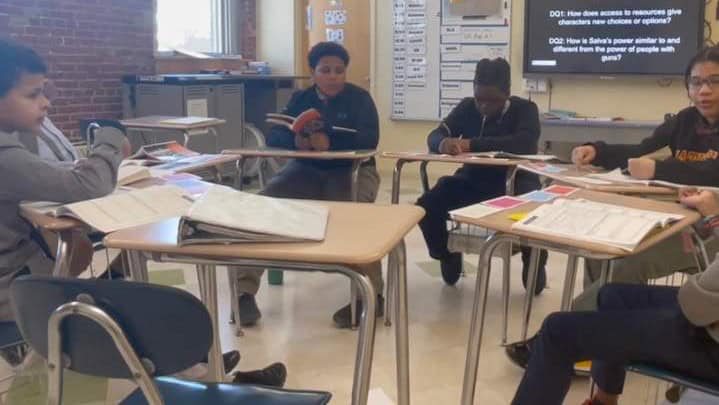
Once he had introduced his students to this interpretation, Patrick spent two class periods orienting students to R.E.A.L.® Skills and Routines (student-led rituals for preparation, facilitation, goal-setting, note-taking, and reflection). Then, throughout the year, students used R.E.A.L.® to discuss a range of texts – seeing first-hand that they could use these skills to talk about different topics.
Discussion Is a Team Sport
A successful discussion is like a basketball game: the whole team works together to answer a question or advance the ball down the court, and individual players make real-time decisions about how to help their teammates achieve that common goal. At the end of the game, the coach offers the team feedback, and the players debrief how it went.
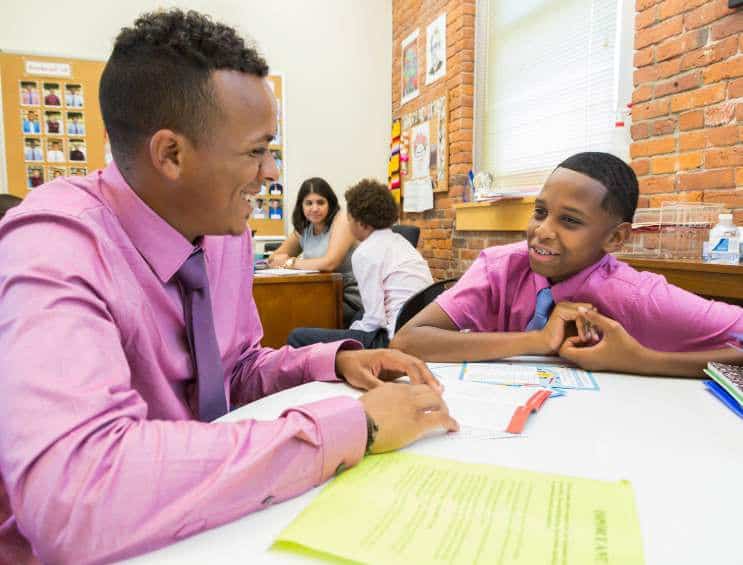
Coach, Not Referee
“I tell the kids: there’s not always a right or a wrong move for a speaker, but each move does have a different effect,” says Patrick. “It gets them thinking: how can I set up the next person? Just like in basketball: how can I set up the shooter down at the net when I’m way back at the half court? Introducing discussion as a menu of discrete moves – relate, excerpt, ask, listen – makes it feel achievable.”
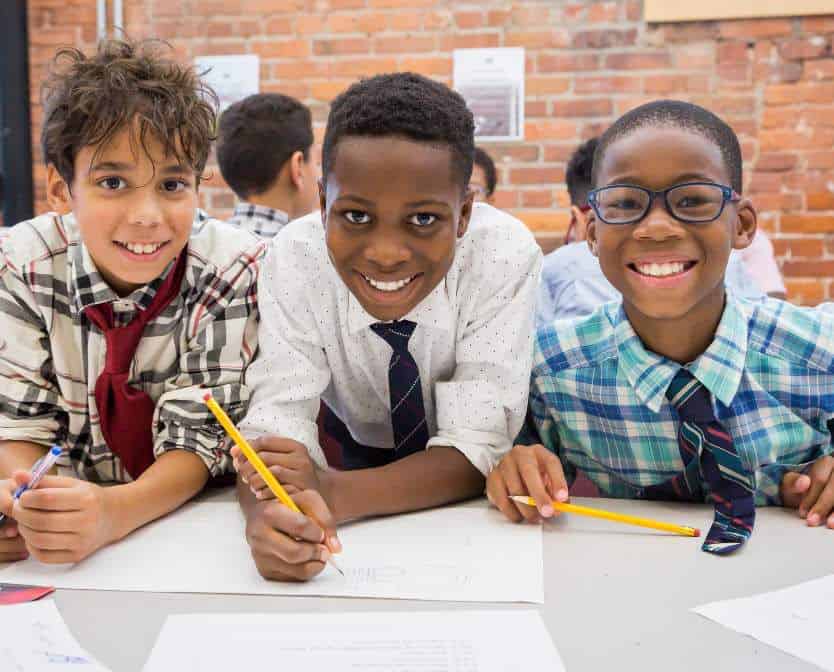
The Results
In one year, R.E.A.L.® helped Nativity Prep sixth graders name, practice, and transfer the skills of live conversation – and rediscover the joy of thinking together.
Every Student’s Voice, Every Discussion
Patrick reflects that an increase in equity and student agency is perhaps the most visible impact of R.E.A.L.® Discussion. “By breaking the mystery of a ‘good discussion’ into teachable, learnable skills, R.E.A.L.® invites all students – not just the extroverts – to set achievable goals, participate intentionally, and grow. It gives greater access to everyone in our classroom to participate. It never gets old hearing every kid’s voice, every discussion, and watching them make space for each other.”
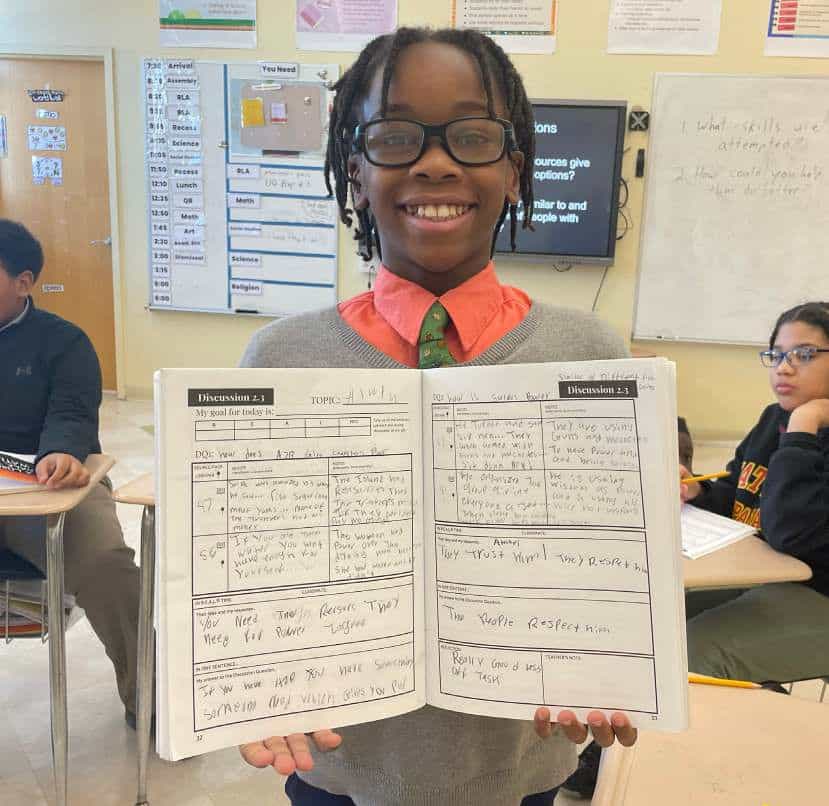
Student notes in their Discussion Portfolios confirm that they, too, delight in having a way to make space for each other.
Teacher as Coach
R.E.A.L.® shifts agency to the students rather than allowing them to rely on Patrick to lead discussions and highlight revelatory ideas. “With R.E.A.L.®, it’s no longer me upfront telling the boys something they need to understand. They generate that understanding for themselves, and that’s where learning happens. That’s where learning sticks.”
When he’d enacted other discussion methods, Patrick found himself too involved in the actual discussion – too likely to point out a core theme or interesting close read, too loud a voice among his students. R.E.A.L.® enables him to serve as coach rather than lead participant by empowering his students with the tools they need to make their own “moves” in discussion.
“The first R.E.A.L.® discussion can be messy… R.E.A.L.® helps them name it, and together we solve for it.”
“And that’s when we return to the four skills: R,E,A,L. I help them imagine what paths might have led to other outcomes – and next discussion, they make different decisions…and they can’t wait to talk through that in the next debrief!”
— Patrick Farmer
Practice for Writing & the “Real World”
The independence students build through this process prepares them for longer writing assignments. Students leave discussion ready to write – with ideas about themes, takeaways from the book, and topic sentences prepared. Patrick uses the R.E.A.L.® model to align discussion with his writing assignments, and R.E.A.L.® skills transfer directly to writing – particularly students’ ability to articulate connections across texts (relating) and incorporate textual evidence (excerpting).
Students find yet another purpose in R.E.A.L.®: they are quick to explain how these skills impact their lives beyond school. Reflections like these show the power of purpose for students: by giving children space to articulate their dreams for the future, classroom work like R.E.A.L.® can take on deeper meaning – even for eleven-year-olds.
“If you want to try out for president, you need to discuss how and what you’re gonna change.”
— Student on the real-life application of the R.E.A.L.® skills in his future
Cultivating Interdependence
Patrick relishes how R.E.A.L.® Discussion helps students begin to recognize both the power of their individual voices and the utility of collaborating to create something bigger than themselves – especially as they grow up in a competitive and polarized world.
Patrick remembers their final debrief:
“The kids started to realize that wait…all these themes are connected! They couldn’t have gotten to that point of understanding without each other. And they were so excited – jumping out of their seats. They were so into it. And that’s the ultimate goal of R.E.A.L.®, right? The thrill and excitement and joy of building an idea together, thinking together, and reaching a new understanding together. In today’s world, that’s powerful.”
Building Foundational Life Skills with R.E.A.L.®
Nativity Prep prides itself on cultivating “men for others,” who are prepared to thrive both in academic environments and in their communities. By deploying R.E.A.L.® in humanities classrooms, the school demonstrated its commitment to building foundational life skills that help students live the school’s mission.
By working with R.E.A.L.®, Nativity Prep is empowering young men to express themselves, listen deeply, and build ideas together – skills they will use for the rest of their lives.
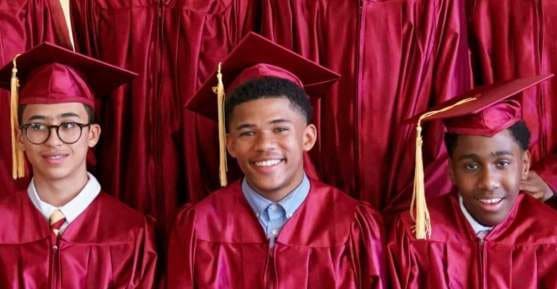
R.E.A.L.® breaks the mystery of a ‘good discussion’ into teachable, learnable skills. And that allows students to set goals and grow. It deepens discussions and gives greater access to everyone in our classroom to participate.
—Patrick Farmer, Middle School Humanities Lead
R.E.A.L.® partners with schools to teach, measure, and celebrate the live discussion skills students need for school and life. Reach out today!
Keep Exploring
See how more partner schools are transforming discussion.
 Blair Academy
 Girls Preparatory School
 Villa Duchesne