R.E.A.L.® Discussion
at Villa Duchesne
A case study on relational learning at
Villa Duchesne School of the Sacred Heart (St. Louis, MO)
About the School
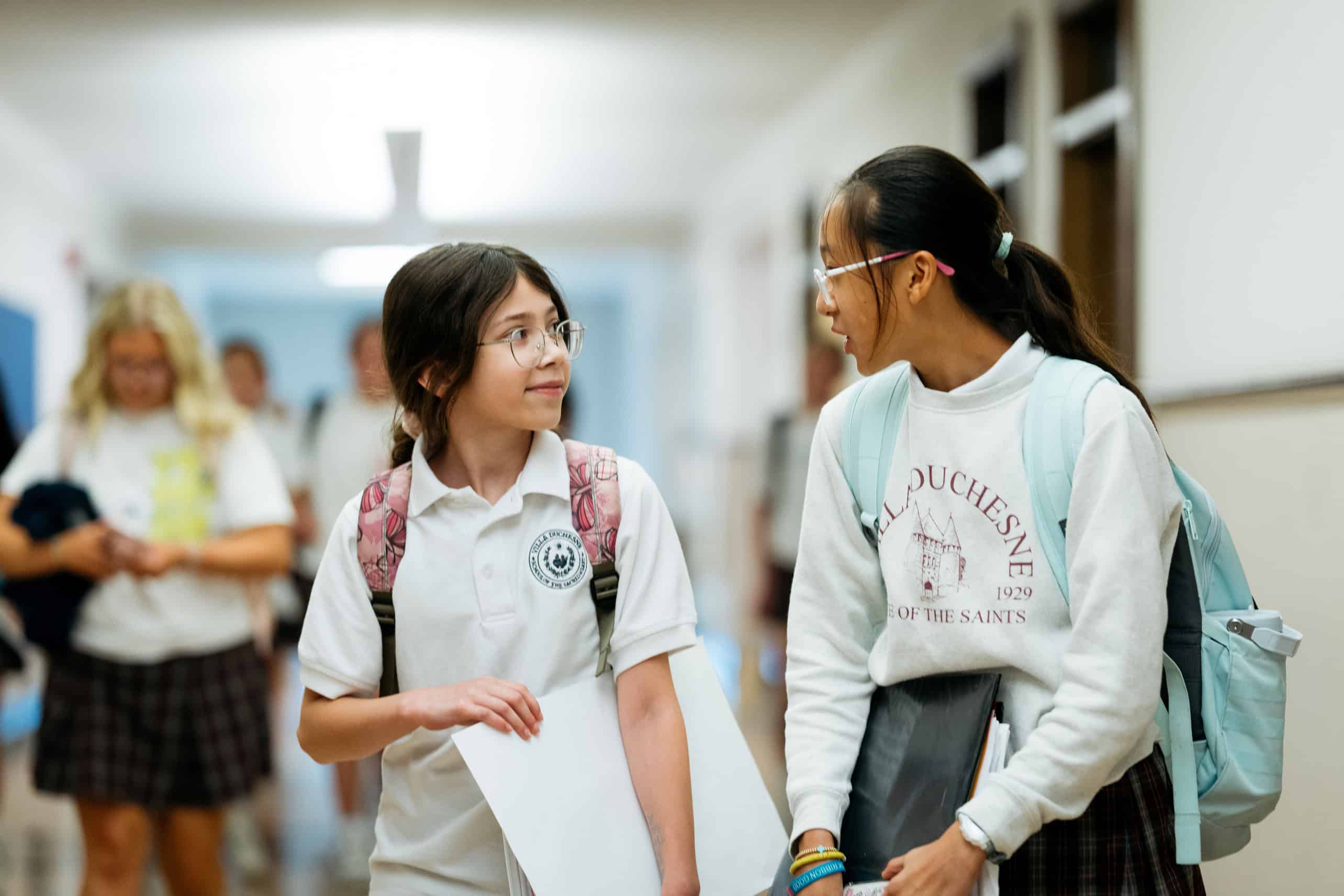
Relational learning has always been mission-critical at Villa Duchesne School of the Sacred Heart, a Catholic, independent school founded in 1929 in St. Louis, Missouri. Villa’s mission—“to transform the world, one child at a time”—reflects a conviction at the heart of Sacred Heart education: that “the strength of Sacred Heart education lies in the building of relationships around our values.”
As a Sacred Heart school, Villa is guided by the Sacred Heart Goals and Criteria, a set of values that call the school community to “model and teach respectful dialogue in support of clear, direct, open communication” and to “practice and teach with a spirit of peace and reconciliation the principles of non-violence and conflict management.”
In our increasingly tech-centric world, values like these have informed Villa’s approach to teaching and learning, leading the School to develop a robust approach to Artificial Intelligence—while simultaneously doubling down on the importance of teaching, measuring, and celebrating Human Skills.
For the last three years, R.E.A.L.® Discussion has been the centerpiece of Villa’s Human Skills approach. It’s a program often referred to as “The Other AI” because it teaches students growing up in our distracted, divided, and digital world the art and science of authentic interaction.

“When we hear relational learning, it’s easy to just think: small class sizes! That’s a given here. Teachers know kids by name, and we know what’s going on in their lives, but there’s so much more to it.
R.E.A.L.® Discussion is an example of a signature experience that actually brings relational learning to life, teaching the skills students need to express themselves confidently, listen deeply, navigate conflict, manage attention, and sit with ambiguity. These durable skills are what students will need in the future—far beyond their Villa days!”
Stacy Henning
Director of Academics
The Vision
“We first approached R.E.A.L.® Discussion as a pedagogical technique—a way to get better at what we already did: facilitating class discussion,” Henning recalls.
However, once Henning and her colleagues learned the R.E.A.L.® Discussion model, the ambition changed. According to Henning, “This became about so much more than better class discussion—and about the entire school, not just one or two classrooms. R.E.A.L.® gave us a vertically and horizontally aligned approach to discussion skills—one that maps perfectly to our Mission, that students take with them throughout the school day and year over year, and that teachers see as a consistent, but not creatively constraining, language.”
As Alice Dickherber, Head of School at Villa, reflects:
Alice Dickherber | Head of School at Villa Duchesne
The Strategy
Today’s thriving R.E.A.L.® Discussion program is the result of a multi-year strategy that spanned divisions and departments.
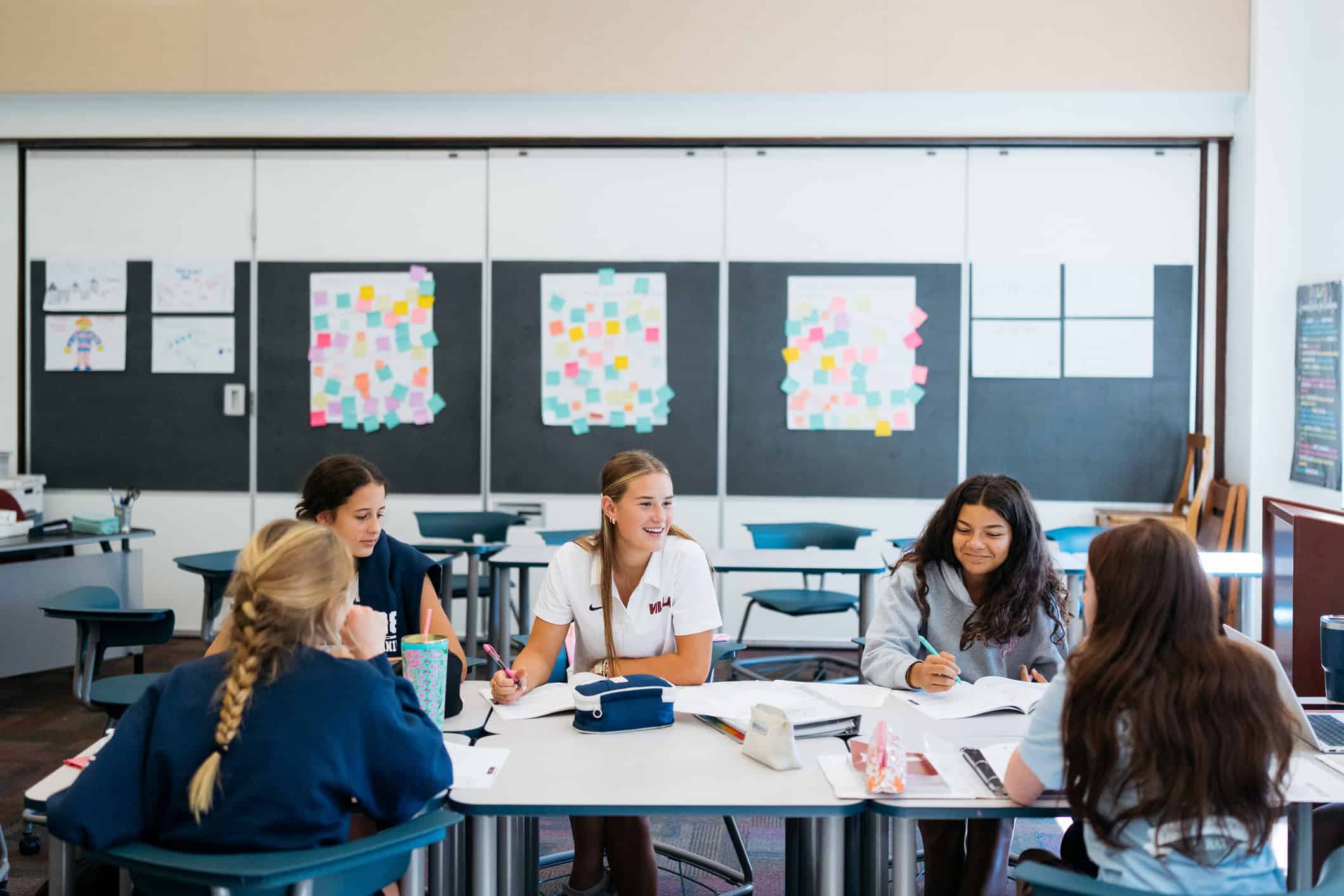
Humanities teachers across English, History, and Theology trained in the R.E.A.L.® method and began using it in their 6th through 9th grade classrooms. Fundamentally, this shifted discussion from being “ping-pong” style (teacher, student, teacher, student) to “pinball” (students talk to each other, and the teacher coaches from the sidelines). This alignment across humanities departments and grade levels ensures consistency of student experience and saves everyone time.
Then, school leaders connected this work to the broader Sacred Heart Goals and Criteria and positioned it as a parallel initiative to their developing policies on AI.
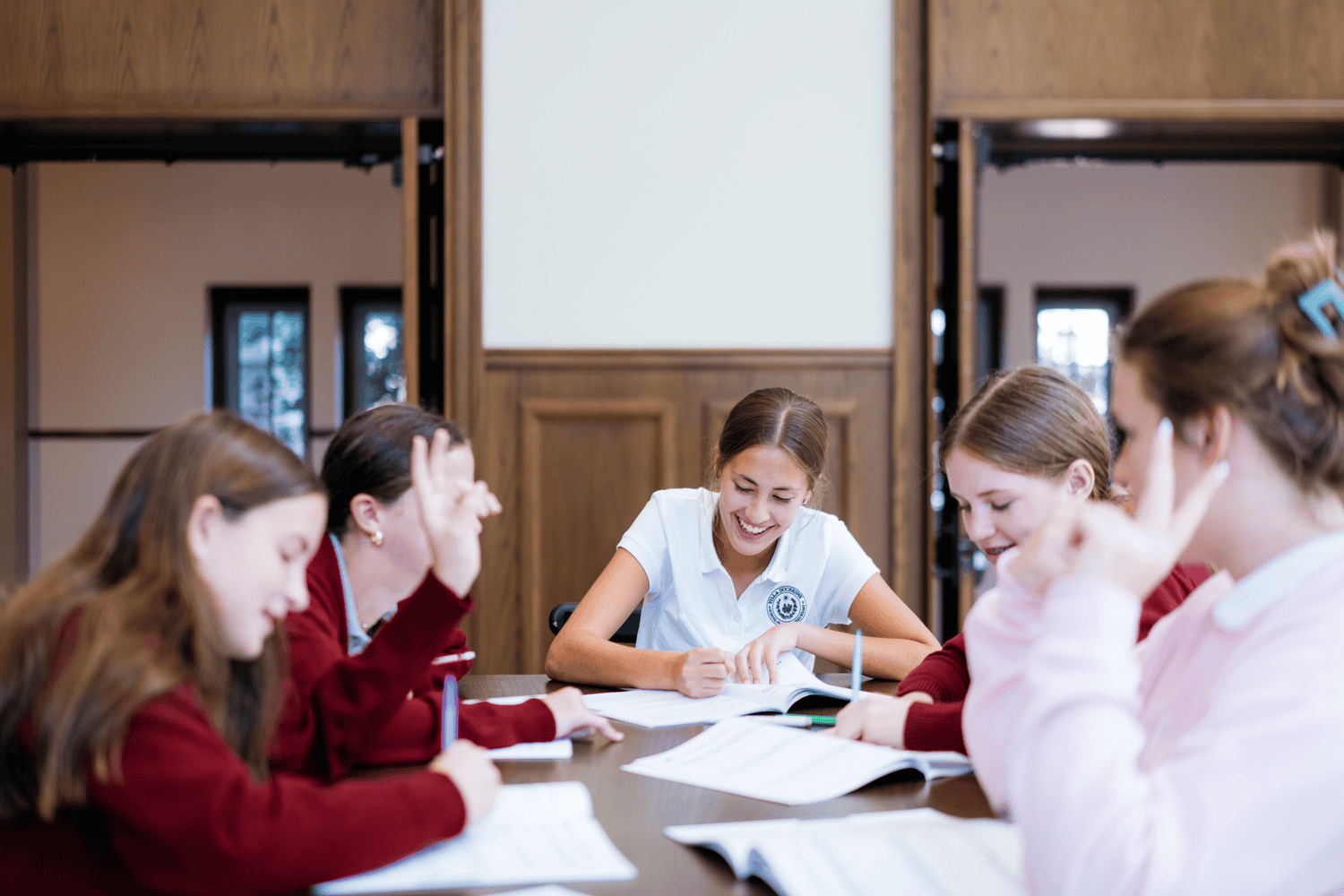
Committing to cultivating The Other AI—authentic interaction— in each classroom is more than just how discussion is run. It’s a philosophy. It’s a practice. It’s a shared skillset. It’s a daily celebration of the beauty of human connection. It’s a way to lean into our School’s core values every day.
The Results
The impact of R.E.A.L.® Discussion can be seen across students, teachers, and administrators!
Student Perspectives
Students reflect on their growth in R.E.A.L.® Discussions three times a year, and their reflections are earnest, eager, and thoughtful testaments to their growth in both academic and social skills.
“I know I’m going to be able to get my voice in if I have something to say.”
Teacher Perspectives
Balancing the needs of introverted and extroverted students is one of the most classic challenges teachers face when it comes to discussion. English teacher Danielle Thurm notes that this is exactly where R.E.A.L.® made the biggest difference for her: “R.E.A.L.® works for both introverts and extroverts—it gives girls tools to self-monitor, make space, and celebrate each other’s contributions. When the students get in their discussion groups, they are expected to self-track and call each other in, saying things like, ‘Come on, you got this—everyone let her talk.’ It’s amazing to watch the attention and generosity they extend to each other.”
Students needing to be “right” or seeing conversation as something to “win” can be another challenging classroom dynamic, especially in today’s world, where true discourse is rarely modeled! But R.E.A.L.® teaches the art and science of discussion, not debate. What does this look like? One example: after each R.E.A.L.® discussion, students are prompted to reflect in writing on how “a classmate has changed or challenged my thinking.” Each class ends with a routine called Shout-outs, where students share those reflections out loud. “Shout-outs sound simple, but they are pure magic,” says Henning. “First, the kids have to hone the skill of active listening. Then, in shout-outs, they feel heard by each other (not just the teacher). They learn it’s OK to change their mind, and they practice public intellectual humility. This is both cognitively and relationally rigorous—and the girls come to cherish the tradition.”
% of students who report that they feel confident (i.e. it isn’t hard or scary) to disagree in a graded class discussion
“I don’t think the teacher needs to help facilitate discussion for it to feel safe.”
Looking Forward
Middle School Principal Rachel de Almeida Oliveira puts it directly: “These are human skills that AI is not going to replace. No matter how advanced technology becomes, human connection will still matter. Until we had R.E.A.L.®, these ‘soft’ but important skills like discussion were hard to measure—now we are able to see students’ growth. As a school leader, that gives me so much confidence, and honestly, joy! I am so proud to know we are living into our Sacred Heart Mission.”
Three years into the program, R.E.A.L.® Discussion has become more than a technique for better class discussions at Villa Duchesne—it is a daily, lived expression of the school’s mission “to transform the world, one child at a time.” In an era when authentic human connection can no longer be assumed, Villa’s investment in “The Other AI” shows that teaching students to talk—and truly listen—to one another may be one of the most future-ready skills a school can offer.
R.E.A.L.® partners with schools to teach, measure, and celebrate the live conversation skills today’s students need for learning—and real life. Reach out today!
Keep Exploring
See how more partner schools are transforming discussion.
 Blair Academy
 Girls Preparatory School
 Nativity Preparatory School