

by Sidra Smith, PhD
Sidra Smith, Head of Professional Learning at R.E.A.L. Discussion, shares her perspective as an educator and leader who has spent years designing and leading faculty summer reading experiences across schools—and now supports teams in turning those experiences into meaningful, schoolwide professional learning.
For many years, spring marked my “summer reading” season. I’d narrow a shortlist, planning to use spring break to read and return ready to propose a book or a few options for faculty. I’d imagine the conversations my colleagues would have, certain they’d see their students in the text and want to talk about it together.
Then I’d work backward from August: ordering books, drafting questions, and considering how to group people for meaningful discussion. I’ve been lucky to work at schools willing to buy a book for every adult, a small but meaningful signal that their intellectual lives mattered. I still remember leading my first summer read, poring over A Hope in the Unseen and feeling both the weight and joy of shaping a shared experience.
Of course, it didn’t always land the same way. Some years, conversations ran long and spilled into hallways. In other years, people showed up politely but never quite took off. Across different schools and contexts, a clear pattern emerged: when summer reading worked, it wasn’t because of a perfect book. It was because the experience involved several important jobs at once.
That realization now shapes my work at R.E.A.L. Discussion. In professional learning with schools, we focus on designing shared experiences that intentionally do the same work:
- building culture across teams
- advancing strategic priorities
- modeling the kinds of discussion and thinking we want students to develop
Summer reading is culture-building.
At its best, summer reading creates a shared experience that cuts across roles and divisions. Teachers, coaches, administrators, and staff are all engaging with the same ideas, even if they interpret them differently. That shared experience quickly becomes shared language. Phrases from the book show up in meetings and hallway conversations, giving people shorthand for complex ideas about students, learning, and school culture.
When designed well, it also creates space for connection. Thoughtful grouping and strong questions allow colleagues who rarely sit together to have real conversations, not just logistical ones. Over time, that builds trust and strengthens relationships across the adult community in ways that are hard to manufacture otherwise.
Summer reading is strategy-in-action.
Summer reading can also serve as an early entry point for strategic priorities. When a school names a focus like belonging, well-being, or student engagement, choosing a book in that lane gives faculty time to sit with those ideas before any formal initiative begins. It creates a low-stakes space to ask, “What would this actually look like with my students?”
The impact is rarely immediate or dramatic. Instead, it shows up in small but meaningful shifts: how people talk about attention, stress, success, or which students are thriving. Over time, those shifts accumulate and create a kind of soft launch for larger changes. By the time new structures or programs are introduced, the underlying ideas already feel familiar and shared.
Summer reading models important lessons for students.
Summer reading also carries symbolic weight. When students see adults reading, referencing ideas, and engaging as learners, it offers a concrete model of what it means to keep growing intellectually. It reinforces that reading and reflection are not just student tasks, but lifelong practices.
For faculty, the experience signals something equally important. Providing a book, carving out time to read, and protecting time for conversation communicates that their intellectual lives matter. When the experience feels like an invitation into shared learning, not an obligation, it becomes a form of care, not just professional development.
When summer reading works, it’s not because everyone loved the book. It’s because it’s doing quiet, important work in the life of the school. That work looks something like this:
- Signaling that the school values faculty as thinkers by investing time, money, and attention in their intellectual lives.
- Giving faculty a shared experience across divisions, departments, and roles.
- Developing a shared language for talking about students, teaching, and school culture.
- Making mission statements and strategic priorities feel concrete and lived‑in, not just framed on a wall.
- Creating structured opportunities for real conversation and relationship‑building among adults who rarely sit together.
- Supporting professional growth and reading habits in a way that feels more invitational than evaluative.
- Modeling lifelong learning for students by letting them see that the adults in their community also read, wrestle with ideas, and change their minds.
At its best, faculty summer reading is one of the simplest ways schools can honor the intellectual lives of the adults who make everything else possible. It’s a relatively small investment, some books, some time, some thoughtful design, that can create shared experience, shared language, and a clearer connection between what we say we value and what actually happens once students walk through the doors.
Not everyone finishes the book, and not every conversation takes off. But over time, it can nudge school culture toward more curiosity, more coherence, and more care for the humans doing the work. That still feels worth planning for every spring.
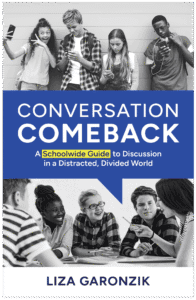
If you’re thinking about how to approach summer reading this year, Conversation Comeback: A Schoolwide Guide to Discussion in a Distracted, Divided World offers a practical, schoolwide approach to doing this work with intention. The book contains chapter takeaways and reflection prompts for leaders, faculty, and community conversations. Order in bulk and we’ll send you a link to sign up for a 30-min Author Talk with Liza Garonzik. And if you’re looking for support in designing professional learning that actually sticks, you can learn more here: https://realdiscussion.org/services/